
Rehab Centres for the Elderly in London and Kent: Your Essential 2026 Checklist
- Aim 4 More Physiotherapy
- Apr 25
- 12 min read
Last Tuesday, Margaret’s family were told she was ready for hospital discharge, but the "pathway" documents left them more confused than comforted. It’s a scenario many families in London and Kent face when searching for rehab centers for elderly; you want the best for your parent, yet the fear of them losing their independence permanently is overwhelming. You might worry that a costly residential care home is the only path left, especially when the NHS system feels stretched and difficult to navigate. We understand that your primary goal is to see your loved one back on their feet, moving with the confidence they had before.
At Aim 4 More Physiotherapy, we believe everyone deserves the chance to recover stronger, move better, and live more. This guide will help you navigate the local landscape, ensuring you find the specialist neurological and musculoskeletal support required for a successful journey home. We'll provide a clear 2026 checklist to help your relative restore their mobility and regain their zest for life. You're about to discover a practical plan to move from hospital uncertainty to a specialist recovery journey that brings your family genuine peace of mind.
Key Takeaways
Understand the 2026 standard for multidisciplinary recovery and how it focuses on restoring gait, balance, and independence for your loved ones.
Use our structured framework to evaluate rehab centres for elderly patients, ensuring your chosen provider specialises in geriatric and neurological care.
Compare the 24/7 support of residential convalescent homes against the targeted, cost-effective sessions offered by specialist outpatient clinics.
Navigate the critical first 72 hours after hospital discharge with expert advice on coordinating with NHS teams in Lewisham and Bromley.
Discover how a "Home Visit" rehabilitation model brings specialist clinical expertise directly to your door, helping patients recover stronger in their own environment.
Table of Contents Understanding Rehabilitation Centres for the Elderly in London The Essential Checklist for Choosing an Elderly Rehab Provider Comparing Residential Care Centres with Specialist Outpatient Clinics Planning the Rehabilitation Journey: From Hospital to Home Why Aim 4 More is the Trusted Choice for Elderly Rehab in SE London
Understanding Rehabilitation Centres for the Elderly in London
In 2026, a rehabilitation centre for the elderly is far more than just a place for convalescence. These facilities have evolved into sophisticated hubs for multidisciplinary recovery, where medical expertise meets personalised care. If you are searching for rehab centers for elderly residents in South East London or Kent, it's vital to understand that the focus has shifted towards active restoration. The primary goals are no longer just about "getting by" but are centred on restoring gait, improving balance, and managing complex neurological conditions with precision.
Understanding What is Geriatric Rehabilitation is the first step in choosing the right path. In London, you'll find three distinct types of care. Acute hospital rehab provides intensive medical monitoring immediately after a crisis. Community beds offer a bridge between hospital and home, often funded by the NHS or local councils. Finally, private specialist clinics in areas like Beckenham and Bromley provide bespoke, intensive programmes that allow for a faster return to optimal health. A holistic approach is essential here, combining physical strengthening with the emotional support needed to regain your sense of self.
Who is Elderly Rehab For?
Rehabilitation is a vital lifeline for several specific groups of seniors. Post-operative patients, particularly those recovering from hip or knee replacements, require targeted musculoskeletal support to ensure their new joints function correctly. Stroke survivors benefit from intensive neurological rehabilitation to rebuild the neural pathways required for motor skills. We also see many seniors experiencing "deconditioning." This is a rapid loss of muscle strength and function that often occurs after a short illness or a five-day hospital stay, making professional intervention crucial to prevent a permanent loss of mobility.
The Role of the Physiotherapist in the Rehab Journey
Our specialist physiotherapists act as the architects of your recovery. They look beyond the immediate injury to diagnose underlying mobility issues that might have been present for years. This often involves assessing how a physical weakness, such as reduced ankle stability, contributes to a psychological fear of falling. By addressing both the body and the mind, we help you overcome the hesitation that often follows a health setback. Holistic rehabilitation is the integration of strength, balance, and confidence. Our team focuses on these pillars to ensure you don't just recover, but thrive. You can explore our full range of specialist services to see how we tailor these journeys. We want to help you Recover stronger, Move Better, Live More!
The Essential Checklist for Choosing an Elderly Rehab Provider
Selecting the right facility from the various rehab centers for elderly patients in London requires more than a quick search. It's about finding a clinical partner who understands that every recovery journey is unique. You need a structured framework to compare clinical expertise against your family's practical needs. A good starting point is reviewing professional advice on how to choose a rehabilitation facility to ensure the provider meets 100% of the safety and quality standards required for geriatric care.
Clinical Excellence and Specialisms
Don't settle for generalist care when dealing with the complexities of ageing. You must verify that every clinician is HCPC registered and possesses specific expertise in geriatric musculoskeletal (MSK) or neurological rehabilitation. If your loved one deals with specific conditions like foot drop or vestibular issues, the provider should demonstrate a wealth of knowledge in these areas. Ask if they use specialised techniques such as acupuncture for pain management. This level of clinical rigour ensures your relative isn't just managing symptoms but is actually achieving optimal health.
Patient-Centred Care and Communication
Effective rehab centers for elderly residents must prioritise transparent, ongoing communication. Check if the provider creates bespoke treatment plans rather than generic, "off-the-shelf" programmes. You should expect regular progress reviews to stay informed about every milestone. It's also vital that the clinic can provide professional physiotherapy reports for GPs or insurance companies. This documentation ensures a seamless continuum of care across the entire medical team, leaving no room for uncertainty during the recovery process.
Accessibility and Flexibility in London and Kent
Location is a primary factor for family involvement. A centre in Bromley or Beckenham is often more convenient for regular visits, which are proven to boost patient morale. However, recovery doesn't end at the clinic door. Look for a provider that offers the flexibility to transition from clinic-based sessions to home visits as the patient improves. This allows them to apply their new mobility skills in their own kitchen or garden. If you're looking for a team that meets your ambition for a full recovery, you might want to view our full range of specialised services to see how we support patients at every stage. Recover stronger, Move Better, Live More!
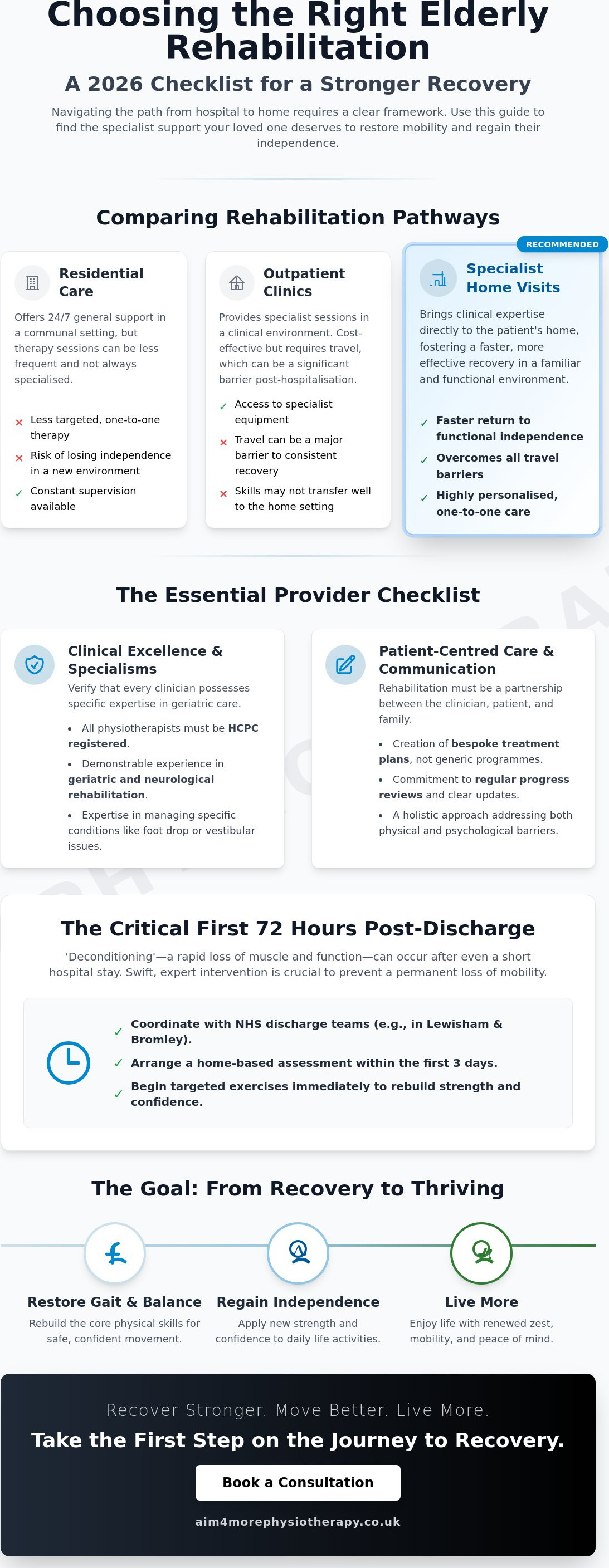
Comparing Residential Care Centres with Specialist Outpatient Clinics
Choosing the right path for recovery often starts with a difficult decision: do you move into a dedicated facility or attend a clinic whilst living at home? Many families across London and Kent worry that residential rehab centers for elderly patients feel overly institutional or clinical. There is also the significant matter of cost. In the South East, a residential rehab bed can range from £1,200 to over £2,500 per week. This price covers 24/7 "hotel" costs and basic nursing, but it doesn't always guarantee the intensive, one-on-one physiotherapy required for a rapid return to independence.
The "Convalescent Home" model focuses on round-the-clock supervision and safety. It's a protective bubble. In contrast, the "Specialist Clinic" or home-visit model focuses on high-impact, targeted sessions. Instead of paying for a bed, you're investing in clinical expertise and hands-on treatment. For many, the psychological boost of sleeping in their own bed is the best medicine. It prevents the "deconditioning" often seen in hospital settings, where patients lose muscle mass rapidly due to inactivity. You can view our transparent prices to see how targeted session packages compare to the high overheads of residential stays.
The Benefits of Home-Based Rehabilitation
The home environment is the ultimate training ground for seniors. Relearning how to navigate your own kitchen or safely step into your own shower is far more practical than practicing in a generic hospital gym. Research suggests that approximately 4.7% of patients in UK hospitals acquire an infection during their stay; staying at home eliminates this risk entirely. Using home visit physiotherapy allows us to tailor exercises to your specific furniture and layout. It turns your living room into a space of ambition and recovery, ensuring you don't just move, but move better in the place that matters most.
When is a Residential Centre Necessary?
Residential rehab centers for elderly people are essential for "Pathway 3" patients. These are individuals with complex medical needs who require 24-hour nursing care, such as those recovering from a severe stroke or complex surgery where wound management is critical. These centres also provide vital respite care, preventing carer burnout for families in Kent who may be physically exhausted. Following NHS best practice for rehabilitation services, the most effective strategy is often a hybrid approach. This involves a short residential stay to stabilise, followed by a seamless transition back to community-based care to reclaim full independence. Recover stronger, Move Better, Live More!
Planning the Rehabilitation Journey: From Hospital to Home
The first 72 hours after leaving a hospital ward are the most influential for your long-term recovery. In areas like Lewisham and Bromley, the NHS discharge teams often operate on a "Home First" model, aiming to move patients back to their familiar environment within 24 hours of being declared medically stable. While this is excellent for morale, it puts the onus on you to have a solid plan in place. Coordination with local rehab centers for elderly should ideally start before you even leave the hospital to avoid a "care gap" where physical progress stalls.
If you're awaiting a scheduled surgery, don't wait for the post-op period to start your journey. Engaging in "Pre-hab" for just 4 to 6 weeks before your date can improve post-operative recovery outcomes by 29%. It's about building a physical reserve so you can recover stronger, move better, and live more!
The Step-by-Step Pathway:
Assessment: Establishing a clinical baseline of your current mobility.
Goal Setting: Defining what "better" looks like for your specific lifestyle.
Intensive Phase: High-frequency sessions to rebuild strength and confidence.
Maintenance: Shifting to long-term health management to prevent future falls.
The First Assessment: What to Expect
Our initial visit is both thorough and encouraging. We use validated physical tests, such as the 30-second sit-to-stand and gait analysis, to create a data-driven map of your capabilities. We focus on SMART goals that connect to your life in London or Kent. We don't just aim for "general improvement"; we aim for "walking to the local Beckenham shops for a paper" or "climbing the stairs independently." We also conduct a "home hazard" sweep to spot loose carpets or low-lit areas that might hinder your progress. This ensures your home is a safe space for your ambition to grow.
Maintaining Momentum and Preventing Relapse
True recovery happens in the hours between our visits. Family involvement is crucial here, helping you stay on track with "homework" exercises designed to build muscle memory and bone density. To ensure you don't lose steam or miss vital sessions, many families utilise multi-session packages to provide a structured, consistent framework for the journey. It's also important to watch for signs that your programme needs a tweak, such as a plateau in your walking distance or increased fatigue. We remain agile, adjusting your plan the moment your needs change.
Ready to start your recovery? Contact our friendly team today to book your home assessment and take the first step toward independence.
Why Aim 4 More is the Trusted Choice for Elderly Rehab in SE London
Selecting the right path for recovery is a significant decision for families in Bromley, Beckenham, and Eltham. While many traditional rehab centers for elderly patients require residents to travel to a fixed facility, Aim 4 More operates as a pragmatic motivator that meets you exactly where you are. We believe that rehabilitation should be a partnership, not just a prescription. Our mission is built on a simple, high-energy promise: Recover stronger, Move Better, Live More!
What sets us apart is our specialist home visit service. We bring the clinical excellence of a professional rehab centre directly to your living room. This approach is particularly effective for seniors who find travel exhausting or disorienting after a hospital stay. By treating you in your own environment, our specialists tailor exercises to your specific furniture, stairs, and layout. We combine musculoskeletal (MSK) expertise with neurological rehabilitation to cover every aspect of your recovery journey, ensuring no symptom is left unaddressed.
Expert Care Across Bromley, Beckenham, and Beyond
Our dedicated team provides vital support to communities across South East London, including Lewisham, Catford, Sydenham, and Bexleyheath. If you prefer a clinical setting for your outpatient sessions, our Beckenham clinic offers a modern, welcoming space designed for optimal movement. We know that the period following a surgery or illness is often a stressful time for seniors. That's why we focus on being a friendly face in your home or at the clinic. Our therapists aren't just clinicians; they're supportive partners committed to restoring your confidence and independence.
Meeting Your Ambition for Recovery
We don't shy away from complex cases that require a wealth of knowledge. Our team is highly skilled in stroke recovery and vestibular rehabilitation, addressing the dizziness and balance issues that often lead to dangerous falls. To ensure your long-term health is managed effectively, we provide comprehensive clinical reports. These documents are essential for tracking progress and can be shared with your GP or family members to maintain a clear picture of your health status.
We're ambitious for your future. Whether your goal is to walk to the local shops again or simply to move around your home without pain, we have the tools to help you get there. Our approach replaces the coldness of a hospital ward with a sense of community and personal care.
If you're looking for an alternative to standard rehab centers for elderly care that offers more personal attention and flexibility, Aim 4 More is ready to support you. You can view our full range of specialist services or check our transparent pricing online. Don't let mobility issues define your future. Book an assessment today to start your journey back to full fitness.
Secure Your Path to a Stronger Recovery
Choosing the right support is the most critical decision you'll make following a hospital stay or a change in mobility. This 2026 checklist demonstrates that the best rehab centres for elderly patients must offer a blend of clinical precision and compassionate care. You deserve a partner who understands that rehabilitation is about regaining independence and confidence within your own home. Aim 4 More bridges the gap between hospital wards and daily life by delivering specialist neurological and MSK clinicians directly to your door.
We provide convenient home visits across SE London and Kent, ensuring your recovery happens where you feel most comfortable. Our team stays focused on your journey through expertly crafted clinical progress reports that track every milestone you achieve. It's time to meet your ambition for a more active lifestyle and move past the limitations of pain or injury. We're here to ensure you recover stronger, move better, and live more. You don't have to navigate this transition alone; we're ready to help you take the next step.
Frequently Asked Questions
How much do private rehab centres for the elderly cost in London?
Private residential rehab centres for the elderly in London typically cost between £1,500 and £3,500 per week. These fees cover 24 hour nursing care, accommodation, and intensive therapy sessions. If you choose a premium facility in central boroughs, costs can exceed £4,000 weekly. It's best to check if your private health insurance, such as Bupa or AXA, covers these specific rehabilitation costs to help manage your budget.
Is home-based physiotherapy as effective as a residential rehab centre?
Home-based physiotherapy is often just as effective as staying in a residential rehab centre for most seniors. Research published in the BMJ indicates that patients frequently recover faster in a familiar environment where they feel safe and motivated. By choosing home visits, you can practice daily tasks in your own kitchen or hallway. This helps you move better and live more independently without the stress of a clinical setting.
Can I get a physiotherapy report for my parents insurance claim?
Yes, we provide comprehensive physiotherapy reports to support your parents' insurance claims. Our specialists document clinical findings, treatment plans, and progress milestones to ensure your provider has all the necessary evidence. We regularly work with major insurers to help patients access the funding they need for their recovery journey. It's a standard part of our professional service to help you navigate the administrative side of private healthcare.
How long does a typical elderly rehabilitation programme last?
A typical rehabilitation programme for a senior lasts between two and six weeks. This timeframe allows our team to address musculoskeletal issues or neurological recovery effectively. Your specific journey depends on your personal ambitions and the complexity of your condition. We monitor your progress at every session to ensure you're on track to recover stronger and return to your favourite activities as quickly as possible.
Do you provide physiotherapy home visits in Bromley and Beckenham?
We provide expert physiotherapy home visits across Bromley, Beckenham, and Crystal Palace. Our friendly team brings all the necessary equipment to your front door, making it convenient for you to receive high-quality care without leaving your home. This local focus ensures we're a trusted partner in your community, helping you aim for more in your physical recovery. You'll see a familiar, friendly face at every appointment.
What is the difference between convalescent care and rehabilitation?
Convalescent care focuses on rest and recovery after an illness, whereas rehabilitation is an active, goal-oriented process to regain lost skills. While convalescence is about "getting better," rehab centres for elderly patients use targeted exercises to improve strength and mobility. Our approach is purely rehabilitative, meaning we don't just wait for you to heal; we actively help you move better and regain your independence through evidence-based treatments.
Can physiotherapy help an elderly person who is afraid of falling?
Physiotherapy is incredibly effective for seniors who are afraid of falling. We use vestibular rehabilitation and balance training to build your confidence and physical stability. Since 30% of adults over 65 experience a fall annually, our programme focuses on strengthening the specific muscles you need to stay upright. We'll help you overcome that anxiety so you can live more freely and enjoy your daily walks again.
Do I need a GP referral to start private rehabilitation for a senior?
You don't need a GP referral to start private rehabilitation with our team. You can book an initial assessment directly with us to begin your recovery journey immediately. This direct access saves you time and allows us to start relieving your symptoms without the wait times often found in the NHS. If we identify a medical issue that requires a doctor's attention, we'll advise you to contact your GP straight away.


Comments